When Insects Were Taken To Court
A Swarm of Ants Is Marching Toward the Crops. Someone Is About to Take Them to Court.
Look at them. Dozens of ants, heading straight for the crops.
This is from an English bestiary, made around 1250–1260.
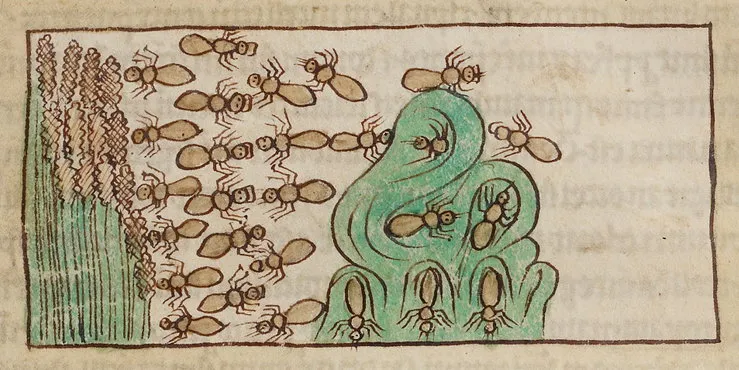
And in parts of medieval Europe, this wasn't just something you watched happen.
It was something you could take to court.
From the thirteenth century onwards, church courts in parts of France, Switzerland and northern Italy occasionally summoned destructive swarms — locusts, beetles, caterpillars and other pests — to answer for the damage they had caused.
Not one insect.
The whole swarm.
Formally. Collectively.
And someone had to argue their side.
Records survive of advocates being appointed to defend the insects, arguing that they too were part of God's creation and had a right to exist.
If no agreement could be reached, the court could order the swarm to leave the affected land within a set number of days.
If they didn't? Excommunication.
By the Church. Officially.
Did the ants comply?
They did not.
The point wasn't really whether the insects understood the judgement. What mattered was that a court had convened, an argument had been heard, and the whole business had been done properly — while, somewhere in the margin, a scribe had already drawn exactly what everyone was so worried about.
Sources
- Northumberland Bestiary, Ms. 100, fol. 23r, England, c.1250–1260. The J. Paul Getty Museum. CC0.