People & Everyday Life
Village life, work, and the odd bit of chaos.
-
Were medieval women always waiting in towers to be rescued?
Were medieval women always waiting in towers to be rescued?
Not quite.
Sometimes they're the ones defending the castle.Look closely at this medieval manuscript image.
A man is climbing a ladder towards a castle wall.
And waiting for him at the top is a woman.
With a sword.
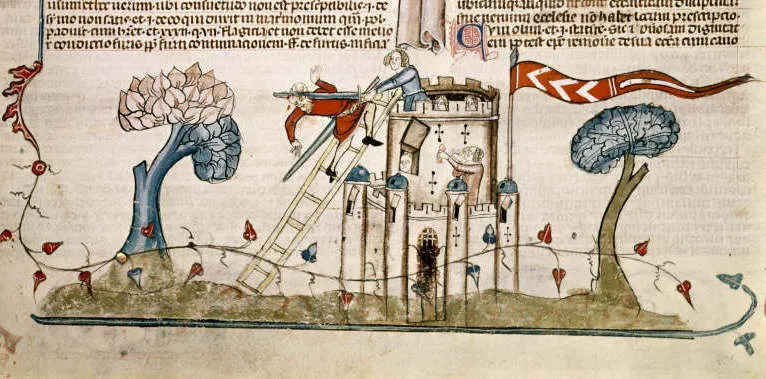
A woman strikes an attacker climbing a ladder as he attempts to storm a castle. Detail from the Smithfield Decretals, England (London?), c.1340. British Library, Royal MS 10 E IV. This is from the Smithfield Decretals, a fourteenth-century English manuscript, made around 1340.
We don't know who she is.
We don't know if the artist had a real woman in mind, or a story, or just liked the idea of it.
But it wasn't as far-fetched as it sounds.
When a husband was away, imprisoned, or dead, responsibility for a castle could fall to his wife — including its defence.
Nicola de la Haye, for example, played a major role in the defence of Lincoln Castle during the First Barons' War.
So maybe this is her.
Maybe it's no one in particular.
Either way, somewhere around 1340, someone decided a woman with a sword on a castle wall was a perfectly reasonable thing to draw.
And I rather like that.
Source
British Library, Smithfield Decretals, Royal MS 10 E IV, England (London?), c.1340.
-
What the Hell Is That Medieval Angel Playing?
What the hell is that angel playing?
It looks a bit like a tiny medieval guitar.
It isn't.
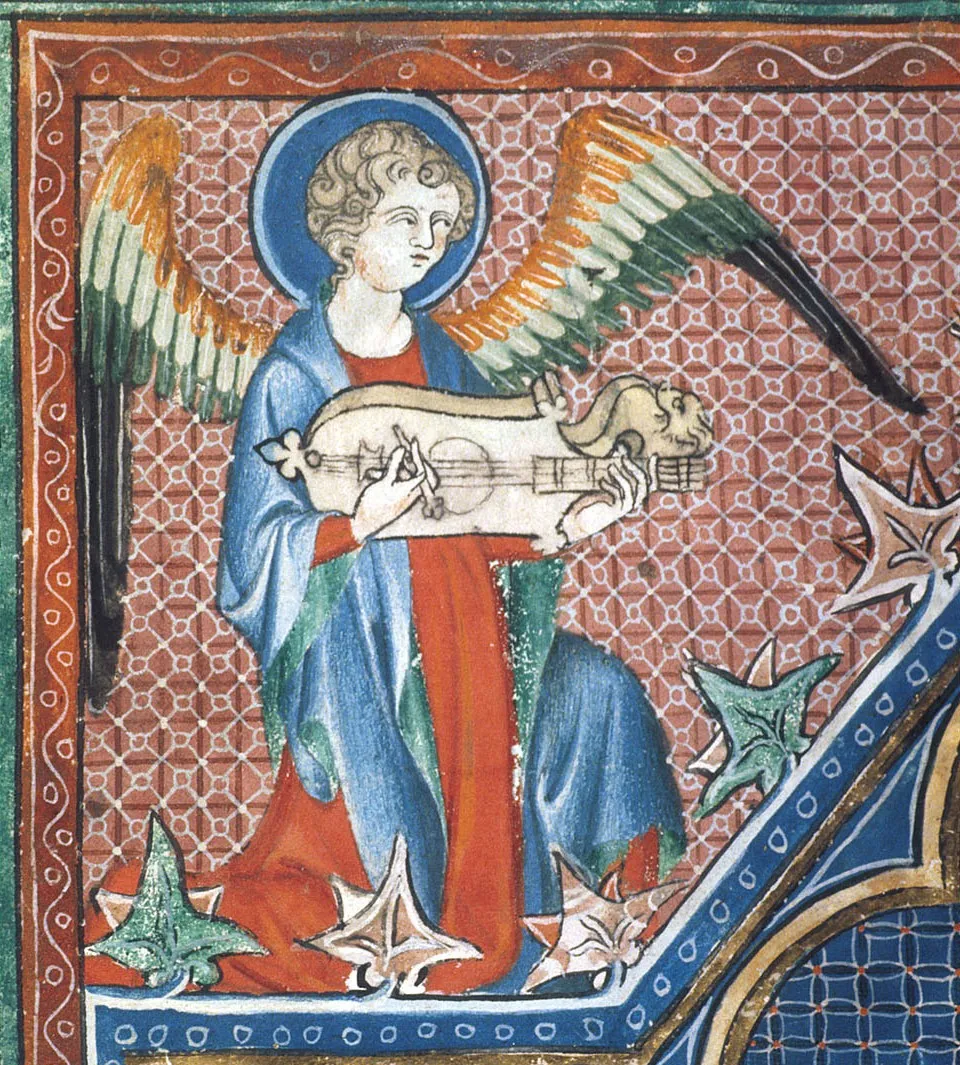
An angel playing a citole from the De Lisle Psalter, England, c.1310 (British Library, Arundel MS 83, f.134v). Public Domain. It's a citole — a medieval stringed instrument that turns up in manuscripts from the thirteenth and fourteenth centuries.
And once you know what you're looking at, you start seeing them everywhere.
This one appears in the De Lisle Psalter, made in England in the early fourteenth century. The angel is playing it with a plectrum, so this isn't some strange medieval artist's invention. The instrument was real.
We don't have a medieval recording, unfortunately. So we can't press play and hear what this particular angel sounded like.
But we do know the citole was a proper musical instrument, played in medieval Europe. It had strings, a wooden body and a shape that looks surprisingly familiar until you actually stop and look at it.
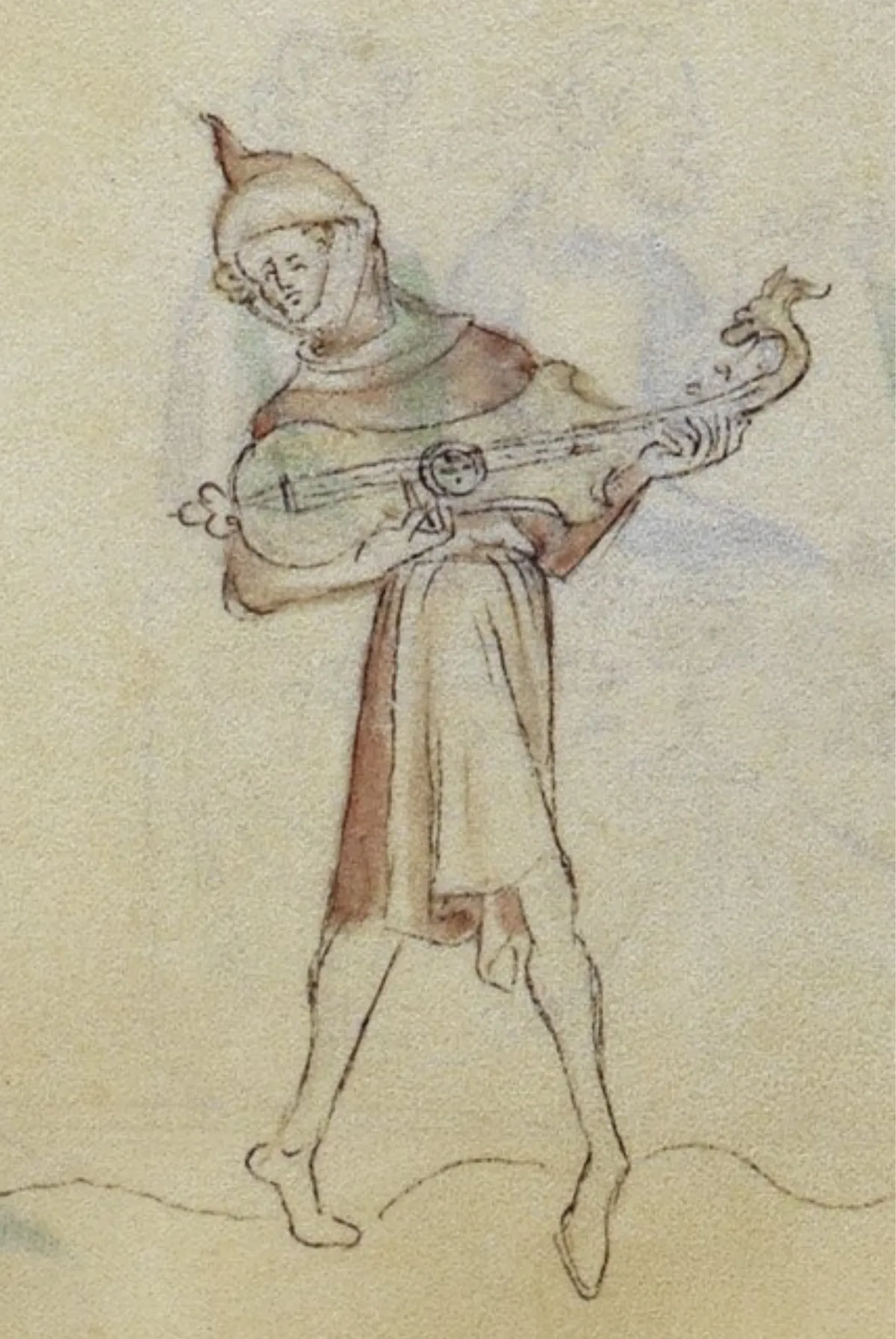
A musician playing a citole from the Queen Mary Psalter, England, c.1310–1320. British Library. Public Domain. And then, at some point, the citole largely disappeared and other instruments took its place.
Which is why most of us have never heard of one.
So there you have it: a 700-year-old musical instrument, hiding in plain sight in a medieval manuscript.
Medieval musicians were considerably stranger-looking than advertised.
Sources & Image
Images:
- Angel playing a citole, De Lisle Psalter, England, c.1310. British Library, Arundel MS 83, f.134v. Public Domain.
- Musician playing a citole, Queen Mary Psalter, England, c.1310–1320. British Library, Royal MS 2 B VII. Public Domain.
Further Reading:
- British Library, Arundel MS 83.
- Wikimedia Commons (image access and licensing).
-
Medieval Tooth Extractions
Someone Is Having Their Tooth Pulled. What on Earth?
Look what I found in a medieval manuscript.
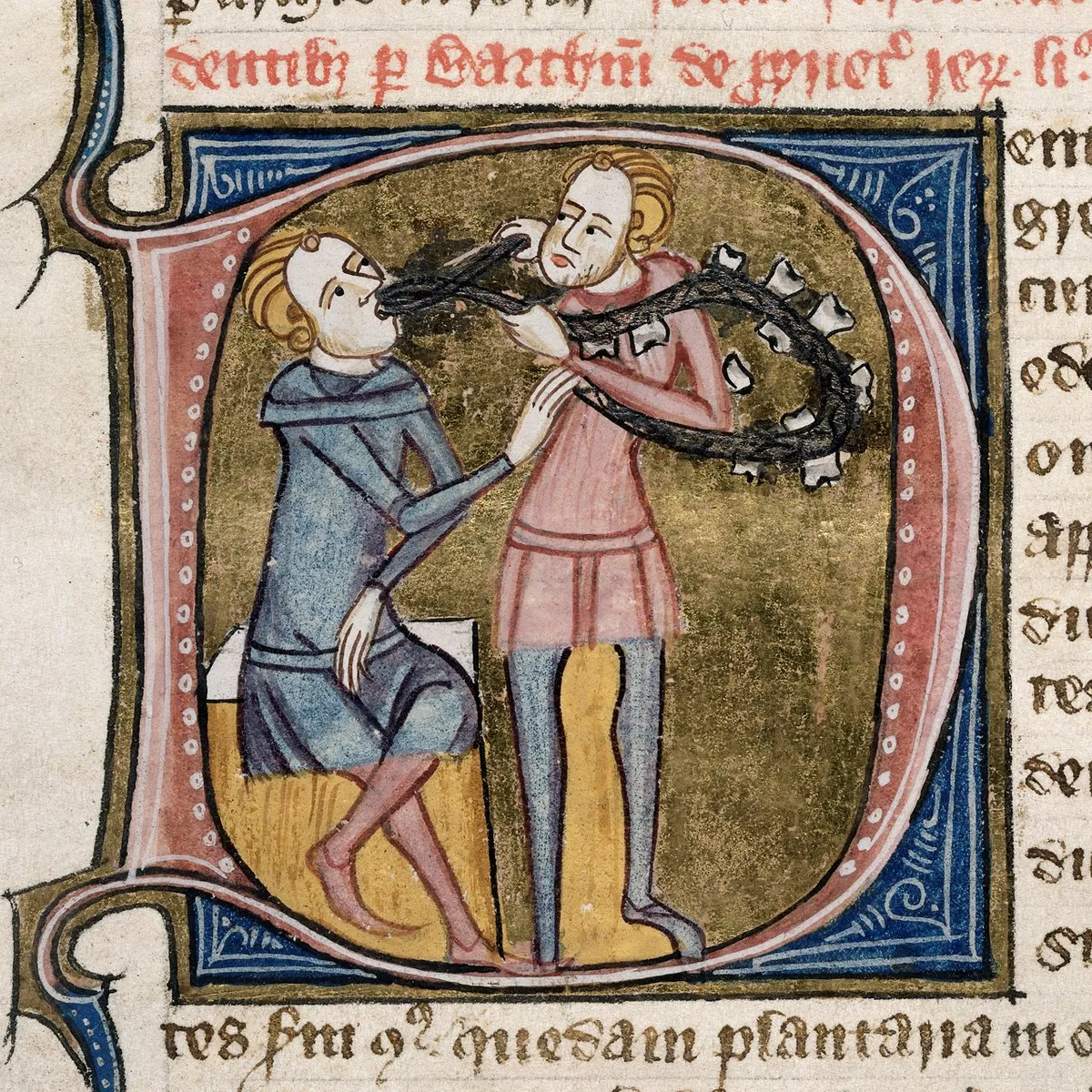
A medieval dentist extracting a tooth, from Omne Bonum, c.1360–1375. Wait. WHAT?
There it is, tucked into a medieval manuscript: a person having a tooth pulled while someone else appears to be doing the pulling.
It's a tiny picture, but it immediately raises a rather obvious question.
What was actually going on when your tooth hurt in the Middle Ages?
So what are we looking at?
This is a historiated initial ‘D’ for dentes (teeth) in the Omne Bonum, a huge encyclopaedic work compiled by James le Palmer in London around 1360–1375.
The image shows a dentist extracting a patient's tooth.
And suddenly this isn't just a strange little medieval picture.
It's a piece of evidence.
Because medieval people had toothache too.
They had teeth that hurt, teeth that broke, teeth that became infected and teeth that eventually had to come out.
They also had some rather interesting ideas about why teeth hurt.
The tooth worm
One long-standing explanation for toothache was the tooth worm — a tiny creature believed to burrow into the tooth and cause pain.
And if you believed a worm was causing your toothache, you needed a way to get rid of it.
Some remedies involved herbs, oils, poultices, prayers and charms. One particularly memorable treatment involved burning henbane seeds beneath the patient's mouth. The smoke produced tiny worm-shaped strands of ash, which could be interpreted as the worms leaving the tooth.
Whether that actually removed anything is another matter.
But the idea makes a little more sense when you remember that medieval medicine was working with a very different understanding of how the body worked.
And when the tooth wouldn't stop hurting?
Sometimes the answer was simply:
Take it out.
The image above gives us a glimpse of that process.
There was no modern dental surgery. There was no anaesthetic as we know it today. The tools and techniques were very different.
And yet the basic problem is instantly recognisable.
That tooth hurts. Get the bloody thing out.
And this is the bit I love.
We don't have to imagine what medieval dentistry looked like.
Someone actually drew it.
More than six hundred years later, we can still look at this tiny image and see a medieval dental procedure taking place.
We don't know everything about the person in the picture. We don't know who they were, what had happened to their tooth, or exactly how the procedure felt.
But we do have this.
A little piece of evidence, sitting inside a manuscript that has survived for centuries.
So the next time your dentist asks if you've been flossing, spare a thought for whoever was sitting in that medieval chair.
Because it could be worse.
They could be reaching for the forceps.
Image Source
Image: A dentist extracting a tooth, historiated initial ‘D’ for dentes (teeth), from the Omne Bonum, compiled by James le Palmer, London, c.1360–1375. Royal MS 6 E VI, f.503v. British Library. Public Domain, via Wikimedia Commons.
-
How Do We Know What Medieval Life Really Looked Like?
<>What do a medical handbook, two prayer books and a book of Church law have in common? Surprisingly, they are some of the greatest windows into everyday life in the Middle Ages.
When people imagine medieval manuscripts, they often picture pages filled with Latin writing, saints and gold leaf. While those things certainly exist, many manuscripts contain something far more unexpected: ordinary people going about their daily lives.
Farmers harvesting crops. Shepherds tending sheep. Women spinning wool. Bakers making bread. Kings fighting battles. These scenes were never intended to be historical records, yet today they provide some of the richest visual evidence we have for understanding life in medieval Europe.
Four remarkable manuscripts in particular have become invaluable to historians. Although each was created for a different purpose, together they preserve an extraordinary glimpse into the lives of ordinary medieval people.
Tacuinum Sanitatis
The Tacuinum Sanitatis began life as a medical handbook written in eleventh-century Baghdad by the physician Ibn Butlan. It explained how food, exercise, sleep and the changing seasons affected health. During the late fourteenth century, wealthy patrons in northern Italy commissioned lavishly illustrated copies, transforming a practical guide into one of the finest visual records of medieval daily life.
Its pages show gardeners, farmers, cooks, merchants and labourers alongside the fruits, vegetables and animals that shaped medieval diets.

Cabbages being harvested, illustrated in the 14th-century Tacuinum Sanitatis . Luttrell Psalter
Created in England between about 1325 and 1340 for Sir Geoffrey Luttrell, the Luttrell Psalter is a beautifully illuminated book of Psalms. While intended for private devotion, its illustrations provide an extraordinary glimpse into medieval English rural life.
Ploughmen work the fields, shepherds tend their flocks, labourers harvest crops and villagers go about their daily lives. Few surviving manuscripts capture the rhythms of medieval England with such warmth and detail.
.png)
Sheep gathered in a medieval sheep pen, illustrated in the Luttrell Psalter . Queen Mary Psalter
Produced in England around 1310–1320, the Queen Mary Psalter is one of the greatest illuminated manuscripts of the Middle Ages. Alongside biblical stories are hundreds of illustrations depicting hunting, animals, historical events and scenes from everyday life.
One striking image shows King Oswald of Northumbria fighting King Penda of Mercia at the Battle of Maserfield in AD 642, demonstrating how medieval artists also recorded important moments from England's past.

Oswald of Northumbria fighting Penda of Mercia at the Battle of Maserfield, illustrated in the Queen Mary Psalter . Smithfield Decretals
The Smithfield Decretals are perhaps the most unexpected of all. Although the text itself is a collection of medieval Church law, the margins are filled with lively and often humorous illustrations that reveal the personalities and everyday experiences of medieval people.
Among its many delightful scenes is an affectionate encounter between a man and a woman at her spinning wheel, reminding us that medieval manuscripts could capture moments of humour, affection and ordinary human life alongside their more serious purpose.
_(c.1340),_f.139_-_BL_Royal_MS_10_E_IV.jpg)
An amorous encounter, illustrated in the Smithfield Decretals (c. 1340). Why These Manuscripts Matter
None of these manuscripts were created to document everyday life. Yet together they preserve an extraordinary record of farming, food, clothing, work, relationships and even historical events. They allow us to glimpse the lives of people whose stories are rarely recorded in written documents.
For historians, these manuscripts are far more than beautiful works of art. They are windows into a world that disappeared centuries ago, helping us understand not only medieval kings and nobles, but also the farmers, shepherds, craftsmen, women and families who shaped life in the Middle Ages.
Image Credits
- Tacuinum Sanitatis. Österreichische Nationalbibliothek, Cod. Vind. Ser. n. 2644. Public domain.
- Luttrell Psalter. British Library, Add MS 42130, f.163v. Public domain.
- Queen Mary Psalter. British Library, Royal MS 2 B VII. Public domain.
- Smithfield Decretals. British Library, Royal MS 10 E IV, f.139. CC0 1.0 Universal Public Domain Dedication.
Sources & Further Reading
- British Library Digital Collections.
- Österreichische Nationalbibliothek Digital Collections.
- Wikimedia Commons (image access and licensing).
-
Why Did Medieval Villagers Hit Things With Sticks?
Every year, medieval villagers walked around the entire boundary of their parish.
They carried willow wands.
They hit boundary stones, trees, ditches and other important landmarks.
And, in some accounts, they also gave the children a memorable introduction to local geography by bumping or pressing them against the boundary markers.
Wait. WHAT?
So what were they doing?
This was Beating the Bounds, a tradition associated with Rogationtide — the three days before Ascension Day.
The procession brought together the rector, churchwardens, local officials, villagers and children, who walked the boundaries of their parish together.
And this wasn't simply a pleasant spring walk.
The boundary mattered.
In medieval England, parish boundaries determined much more than where one piece of countryside ended and another began.
They helped establish which parish you belonged to, where tithes were paid, which court had authority over you, and who held rights over land such as meadows, woodland and pasture.
There were few accurate maps available to ordinary people.
So if everyone forgot where the boundary was, things could get complicated.
So they walked it.
As the procession moved around the parish, important landmarks were identified and struck with willow wands.
Stones.
Trees.
Ditches.
Streams.
Ancient crosses.
The idea was to make sure that the community remembered exactly where the boundary lay.
And that gave us the rather wonderful name Beating the Bounds.
And then there were the children.
This is the bit that makes me stop.
Children were deliberately included in the procession because they were going to be the adults who needed to remember the boundary in the future.
At important points, some accounts describe children being bumped, bounced or pressed against the boundary marker itself.
The theory was simple:
If you gave a child a memorable experience at that particular stone, they might still remember where it was when they were grown.
Whether the children regarded this as an excellent educational opportunity is, unfortunately, not recorded.
But why do it during Rogationtide?
Rogationtide was already a time when communities processed through the countryside and prayed for God's blessing on the fields and the coming harvest.
So the boundary walk combined several things at once:
- religious procession
- communal memory
- local geography
- and the practical business of knowing where the parish ended.
The community walked the land together, prayed for the coming harvest and renewed its knowledge of the parish boundary.
Here's the bit I love.
Today, we look at a boundary on a map.
A line.
A name.
Perhaps a little black dot marking a boundary stone.
But for medieval villagers, the boundary wasn't necessarily something you could simply look up.
You knew it because you had walked it.
You knew the old tree.
You knew the ditch.
You knew the stone.
And, if you were particularly unlucky, you remembered exactly which one you'd been pushed against as a child.
And somehow, the tradition survived.
Beating the Bounds didn't disappear when better maps arrived.
In some places it became more ceremonial, while elsewhere it was revived as a way of preserving local history.
Some English parishes and Oxford colleges still carry out versions of the tradition today.
The medieval necessity may have disappeared.
But the idea of walking the boundary and remembering the landscape has survived.
So the next time you see a parish boundary on a map, remember:
For centuries, people didn't just draw the boundary.
They walked it.
-
A Baker Is Being Marched Through the Street With Dough Around His Neck
A Baker Is Being Dragged Through the Street. There's a Loaf Tied Round His Neck.
He's not carrying it.
It's tied there. On purpose. For everyone to see.
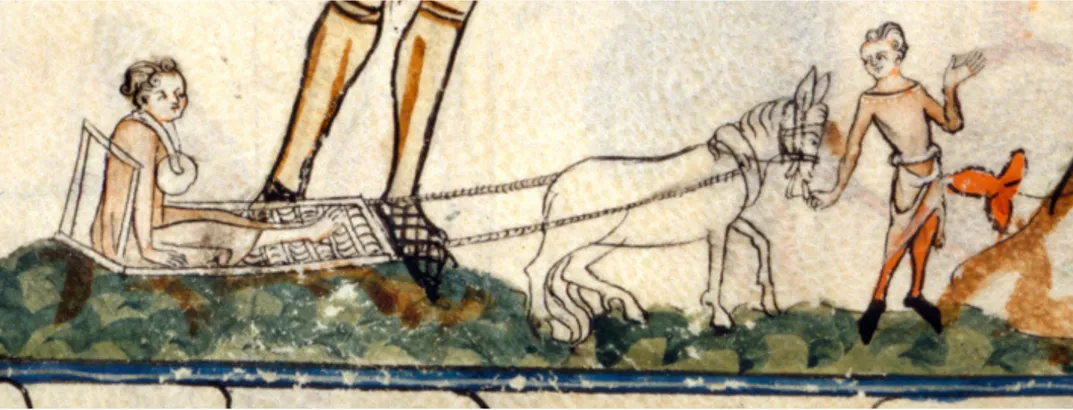
A baker being dragged on a hurdle, with a loaf around his neck. Detail from the Smithfield Decretals, Royal MS 10 E IV, fol. 94, c. 1340. British Library. This is a baker, on a hurdle, being dragged through the streets — with the loaf that got him in trouble hanging round his neck the whole way.
That loaf was underweight.
And in medieval England, that was a serious problem.
Bread wasn't just food. It was the food. So there were laws — the Assize of Bread and Ale — fixing exactly how much a loaf should weigh and what it should cost. Bakers who cheated on the weight risked fines.
Or the pillory.
Or, evidently, this. Dragged through town on a hurdle, defective loaf on display, so every single person he'd ever sold bread to knew exactly what he'd done.
It wasn't subtle. It wasn't meant to be.
So bakers found a way round it.
If twelve loaves needed to hit a certain weight, cutting it exactly on the limit was a gamble. One slightly light loaf, and you could end up on a hurdle yourself.
So they started giving thirteen loaves for the price of twelve.
Not kindness. Insurance.
That thirteenth loaf even had a name — the vantage loaf.
And that's where the phrase comes from.
A baker's dozen. Thirteen, not twelve.
Not because anyone was feeling generous.
Because nobody wanted to end up like the man in this picture.
Sources
- Smithfield Decretals, Royal MS 10 E IV, fol. 94, c. 1340. British Library.
- Assize of Bread and Ale, 1266.
-
The Rent Was 1,000 Eels. And a Pair of Scarlet Hose
In 1238, the monks of Ramsey Abbey were paying their rent in 1,000 eels.
Not metaphorically.
Actual eels.
They also owed two pounds of pepper, two pounds of spice, and a pair of scarlet hose.
All of it was part of an agreement concerning a road across low-lying land near St Ives.
It sounds like someone has invented the strangest medieval shopping list imaginable.
They hadn't.
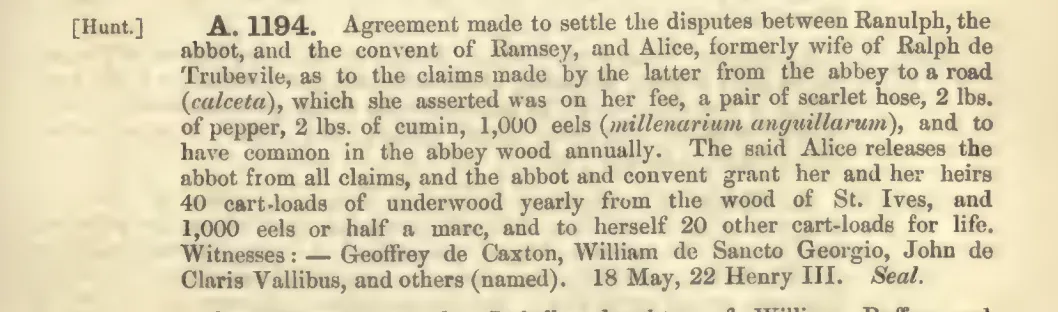
Record of the agreement between Ranulph, abbot of Ramsey, and Alice, formerly wife of Ralph de Trubevile, concerning the road, annual payments and common rights. A Descriptive Catalogue of Ancient Deeds in the Public Record Office, Vol. I, A.1194, 18 May, 22 Henry III (1238). Public domain. The arrangement was already an old one by this point.
Alice, the widow of Ralph de Trubevile, claimed rights connected with the road, the annual payment and common rights in the abbey wood.
So in 1238, she and the abbot of Ramsey settled the dispute.
And the new deal was even stranger.
She would receive 40 cartloads of underwood every year, 1,000 eels — or half a mark instead — and another 20 cartloads of wood for the rest of her life.
The scarlet hose disappeared.
The eels stayed.
And this wasn't some bizarre one-off.
By the time of the Domesday survey in 1086, eel rents were being recorded across England. More than 400,000 eels are recorded in the Domesday material, with the total rising to almost 540,000 when additional surviving charters are included.
Some of the individual payments were enormous.
At Harmston in Lincolnshire, the annual rent was 75,000 eels.
Seventy-five thousand.
In eels.
So why were people paying their rent with fish?
Because eels were plentiful, valuable and surprisingly practical.
They could be caught in large numbers, preserved and stored. In an economy where not every transaction involved coins, a quantity of eels was a perfectly useful thing to owe someone.
They were food.
They were valuable.
And, apparently, they were rent.
Which makes the Ramsey agreement particularly brilliant.
Someone needed to use a road.
Someone else had rights over the land.
They argued about it.
They negotiated.
And eventually they wrote down the solution.
1,000 eels.
Plus spices.
Plus scarlet hose.
Until eventually the hose disappeared and the eels remained.
Harmston, meanwhile, was still dealing in 75,000 of the things.
Medieval England really did have eel rent.
Sources
- H. C. Maxwell Lyte (ed.), A Descriptive Catalogue of Ancient Deeds in the Public Record Office, Vol. I (1890), A.1194. The entry records the agreement between Ranulph, abbot of Ramsey, and Alice, formerly wife of Ralph de Trubevile, dated 18 May, 22 Henry III (1238). Digitised scan via the Internet Archive.
- Victoria County History: Huntingdonshire, Vol. II, pp. 309–314. The history of Hemingford Grey describes the causeway and the earlier annual payment of 1,000 eels, pepper, ginger and scarlet hose, with the arrangement altered in 1238.
- John Wyatt Greenlee, “Seeing All the Anguilles.” The research calculates 403,760 eels in the Domesday records and 539,785 when additional surviving charters are included.